A lawn that smells clean at eight in the morning and drives you inside by two is not a mystery. It is chemistry on a schedule. By the end you will know what produces the smell in Phoenix, what actually removes it, and when the odor means the base under your turf was built wrong.
The Chemistry: Uric Acid, Bacteria and Ammonia
Dog urine is mostly water, yellow pigment, urea and uric acid. On soil, microbes process all four. On synthetic grass the water and urea rinse away, but the uric acid does not: it crystallizes, and those crystals are non-soluble in water, so they bind tightly to the fibers, the backing and the base rock.
That ends the garden-hose theory. Rinsing clears the water-soluble part of the waste and does nothing to the crystals that carry the smell. Environmental bacteria then feed on the trapped crystals and release ammonia gas (NH3) as a byproduct. Heat is the accelerator: when the afternoon sun bakes the turf, bacterial decay speeds up and the ammonia off-gasses harder, which is why a yard smells fresh at breakfast and reeks by mid-afternoon.
Where the Urine Actually Goes: The Base Under the Backing
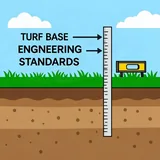
The smell is a symptom, and its source sits below the grass. A turf lawn is built in layers: prepared soil, a compacted aggregate base, the backing and infill, then the surface. If the base has nowhere to drain to, urine sits in it.
The two base types behave in opposite ways. A dense-graded base — Class II road base, CMB or decomposed granite — is packed with fines: microscopic dust, sand and clay that compact into a crust behaving like an impermeable sponge. An open-graded base — clean, washed, angular stone such as #57 crushed stone or CA7 — has no fines to clog the gaps, so the stones lock together and leave roughly 40% void space, a network of miniature drainage channels. A test pour into two cylinders makes it obvious: the dense side ends as a stagnant puddle, the open stone drains the liquid at over 12 inches per hour.
The Cleaners That Cannot Work
Three cheap fixes fail for the same reason the hose fails.
- Enzyme sprays. Enzymes chop odor molecules into smaller pieces but leave the waste in place, so the smell returns once the turf is hot or wet again.
- Bleach. It does not break down uric acid crystals, and it degrades the polyurethane backing, which can void the manufacturer warranty.
- Vinegar and carpet shampoo. Vinegar only masks ammonia, and foaming cleaners leave a residue in the stone base that attracts dirt and turns the grass gray.
What works is biological: live-microbe cleaners contain bacteria that consume the uric acid crystals, converting them into odorless carbon dioxide and water. With the food source gone, the microbes die off on their own.
The 48-Hour Heavy Saturation Tarp Method
For a severe, baked-in smell, the professional maintenance method is a four-step saturation treatment.
- Drench. Mix a concentrated live-microbe cleaner in a pump sprayer and heavily drench the area so it flows through the backing into the stone.
- Wait for dusk. Apply late in the day, because the heat and UV of a full sun day kill the microbes before they can work.
- Tarp it. Lay a heavy, dark plastic tarp flat over the wet turf and weigh the corners down.
- Dwell, then rinse. Leave the tarp 24 to 48 hours, then pull it, let the grass air out and rinse thoroughly.
The tarp is the whole trick: live bacteria need constant moisture, and in dry air the ground dries fast enough that they die before they finish eating. The tarp traps that humidity and creates a dark, warm incubator for the full 24 to 48 hours.
When the Smell Comes Back, the Fault Is Underneath
If the odor returns within days, cleaning is not the problem. A non-woven geotextile weed barrier placed directly under the turf backing acts like a felt pad: it absorbs urine, holds moisture and locks in a permanent smell millimeters below the surface. It belongs only at the very bottom of the excavation, below the stone.
The other silent faults are a base under 4 inches deep, a base rolled in one pass instead of compacted in damp 2-inch lifts, rounded pea gravel instead of angular stone, silica sand infill instead of zeolite, and a hole-punched backing instead of a fully permeable one. Zeolite matters because it is negatively charged and the ammonium ion behind the smell is positively charged, so the infill holds it like a magnet until rain or a hose flushes it down through the open-graded stone.
What to Ask Before You Spend Anything Else on Cleaning
Three questions separate an engineered yard from a carpet: where in the base layers the weed barrier is placed, which aggregate is specified, and how deep and how densely the base is compacted. Get the answers in writing. Phoenix Artificial Turf is an independent matching service, not a contractor. We do not install, clean, inspect or warranty artificial turf. We match homeowners in Phoenix and across the Valley of the Sun with local providers — up to 3 matches, within one business day, and 100% free.
Frequently asked questions
Why does my turf smell like ammonia in the afternoon?
Uric acid crystals are non-soluble and stay trapped in the fibers, backing and base rock. Environmental bacteria feed on them and release ammonia gas, and afternoon heat accelerates that decay.
Does hosing the turf down remove the smell?
No. Rinsing dilutes the water-soluble urea but does nothing to the uric acid crystals, which are non-soluble and stay bound to the fibers and stones.
Enzyme spray or live microbes?
Live microbes. Enzymes only chop up odor molecules and leave the waste behind, so the smell returns when the turf gets hot or wet. Live bacteria digest the crystals and convert them into carbon dioxide and water.
How long does the tarp treatment take?
Two days. Drench the turf with a concentrated live-microbe cleaner at dusk, lay a heavy plastic tarp over it, weigh the corners down and leave it for 24 to 48 hours, then remove the tarp and rinse.
What if the smell keeps coming back?
That points at the base. A weed barrier under the backing holds urine like a felt pad, and a dense-graded base or a base under 4 inches deep traps it.
Sources
- USDA-NRCS Web Soil Survey (soil series, drainage class and depth to water table for a parcel)
- USDA-NRCS Official Soil Series Descriptions (clay and hardpan behavior in local soils)
- National Weather Service — local climate pages and station records (heat and sun load)
Related
Artificial Turf services in Phoenix
Phoenix Artificial Turf Residential Turf
A residential turf installation is a drainage and sub-base project that ends in a lawn, and the published numbers only make sense once you know which of the two you are paying for.

Phoenix Artificial Turf Pet Turf
Pet turf is judged by what happens underneath it, not by how the blades look, and the published specification is a deeper, fully draining base plus an infill that changes the chemistry of the yard.
Phoenix Artificial Turf Playground Turf
A playground surface is bought for one number - the fall height it is rated to - and everything else about the installation serves that number.
Phoenix Artificial Turf Putting Greens
A backyard putting green is a shaped base with a surface stretched over it, and the published specification starts with the speed number the surface has to deliver.
Phoenix Artificial Turf Commercial Turf
Commercial turf is published as a high-traffic, high-drainage surface, and the two numbers that decide whether it works are the annual hours it is rated for and how fast the base sheds water.
Areas we serve
Phoenix
Artificial Turf in Phoenix, AZ - costs, water and soil notes.
Scottsdale
Artificial Turf in Scottsdale, AZ - costs, water and soil notes.
Chandler
Artificial Turf in Chandler, AZ - costs, water and soil notes.
Gilbert
Artificial Turf in Gilbert, AZ - costs, water and soil notes.
Mesa
Artificial Turf in Mesa, AZ - costs, water and soil notes.
Tempe
Artificial Turf in Tempe, AZ - costs, water and soil notes.
Glendale
Artificial Turf in Glendale, AZ - costs, water and soil notes.