the Valley of the Sun does not get a steady week of drizzle: rain arrives in monsoon bursts, onto clay and caliche that barely absorbs it. A turf yard has one job in that weather: move water down and out through the layer beneath the blades, because water that stays under the surface turns stagnant, breeds mould and holds odour. Three numbers decide whether it leaves: the slope, the void space in the stone, and the drain rate.
Rain That Arrives Faster Than the Ground Can Take It
In Phoenix, AZ a monsoon can dump an inch of rain in under an hour onto ground that barely absorbs it, so the lawn cannot rely on the soil below. The base is a drainage structure, not a levelling layer. The aggregate carries the load and passes water at once, and those jobs pull against each other: the tighter the stone packs, the less open space is left. Turf installed over dirt or an old lawn without a built base ruts, wrinkles and ponds within a season.
The Three Numbers: Slope, Void Space and Drain Rate
The slope. One to two percent, falling away from structures — the difference between water shedding off the lawn and water lingering under it.
The void space. About 40%. Washed angular stone with no fines locks together under compaction and keeps roughly 40% of its volume as empty space.
The drain rate. Dense-graded decomposed granite is packed with dust, sand and clay, and under pressure those fines compress into a crust that traps liquid on the surface. Clean no. 57 crushed stone behaved differently: the rocks locked together, still left that 40% void space, and flushed liquid at over 12 inches per hour. Published specifications for pet and commercial systems are higher still, at 30+ inches per hour.
| Base material | Water behaviour |
|---|---|
| Open-graded: #57 crushed stone, CA7 clean gravel | Vertical flow at over 12 inches per hour, no standing water |
| Dense-graded: Class II road base, CMB, decomposed granite | Liquid pools on the surface and stays in the base |
Where the Water Actually Goes
Water leaves a well-built lawn through a fixed stack of layers:
- A high-flow non-woven geotextile over the compacted native soil, seams overlapped 12 inches, so clay cannot migrate into the stone.
- A minimum 4-inch open-graded stone base of washed #57 or CA7 angular stone, compacted in 2-inch damp lifts to 95% Standard Proctor density.
- A thin bedding layer of 3/8-inch clean chip stone (ASTM #8) so larger stones do not show through.
- The turf itself, on a permeable backing that lets liquid through edge to edge rather than between punched holes.
Two details finish the job. The compacted base should sit 1.5 inches below the top of the edging, so turf and infill finish flush. And the grade should lead to native drainage or a defined exit point, with a 6-inch radius clear around trees and shrubs.
What Fails First Under a Storm
First the low spot: water pools in the same place after every rain, because the one to two percent fall was never built or the base has settled. Then surface symptoms: a drainage problem caused by improper base preparation. Then the base itself: once a dense-graded crust or misplaced barrier has soaked up waste, no hose will wash it out.
The other fault is the fabric: a non-woven geotextile laid under the turf backing instead of at the bottom of the excavation traps liquid.
Under-sized excavation is the third: two to three inches is standard for light traffic with no pets, and a light base in an extremely dry desert climate may be as thin as 2 inches. Any yard with dogs needs a minimum 4-inch excavation, up to 6 inches in heavy clay; a shallow base shifts and the surface above buckles.
The Drainage Questions to Put in Writing
| Question | A defensible answer |
|---|---|
| Aggregate? | Washed angular #57 or CA7 clean — not Class II road base, CMB or decomposed granite |
| Weed barrier? | Non-woven geotextile at the bottom of the excavation, seams overlapped 12 inches |
| Excavation depth? | A 4-inch minimum for pet or heavy use, up to 6 inches in heavy clay; 2 to 3 inches only for light use with no pets |
| Compaction? | 95% Standard Proctor density, in damp 2-inch lifts with a plate compactor |
| Slope direction? | Away from the house, toward native drainage or a French drain |
| Stone tonnage? | 1.33 tons of aggregate per 100 sq ft, plus a 10% compaction buffer |
| Borders? | Edging set so the base sits 1.5 inches below the top, with a 6-inch radius clear around trees and shrubs |
Write the answers down — every number is checkable before a truck arrives.
Where a Match Comes In
This site is an independent matching service, not a provider: we do not employ contractors, sell turf or build, inspect or guarantee the work.
The service is free. Describe the yard — including what it does in heavy rain — receive up to 3 matches from az-licensed local pros within one business day, and compare their written scopes. No commissions, no markup, no obligation.
Frequently asked questions
Why does water pool on artificial turf after heavy rain?
It is almost always the base, not the surface: water pooling on artificial turf is published as a drainage problem caused by improper base preparation — dense-graded aggregate compacted into a crust, a weed barrier in the wrong place, or a base too thin.
What slope should a turf base have?
A one to two percent fall away from structures, toward native drainage or a French drain, with the compacted base set 1.5 inches below the top of the edging.
How fast should drainage under turf move?
Clean no. 57 open-graded stone flushed liquid at over 12 inches per hour in a side-by-side test; dense-graded material pooled it. Published specifications for pet and commercial systems call for 30+ inches per hour.
How deep does a turf base need to be?
A 4-inch minimum for a pet yard or heavy use, up to 6 inches in heavy clay. Two to three inches is standard for light traffic with no pets, and a light base in an extremely dry desert climate can be as thin as 2 inches.
Sources
- Phoenix Artificial Turf — artificial turf problems: turf drainage (pooling, causes and fixes)
- Phoenix Artificial Turf — turf sub-base checklist (layer stack, slope, compaction and tonnage)
- Phoenix Artificial Turf — drainage comparison explainer (open-graded vs dense-graded stone)
- Phoenix Artificial Turf — pet turf installation page (permeable backing and 30+ inches per hour)
Related

Artificial Turf services in Phoenix
Phoenix Artificial Turf Residential Turf
A residential turf installation is a drainage and sub-base project that ends in a lawn, and the published numbers only make sense once you know which of the two you are paying for.

Phoenix Artificial Turf Pet Turf
Pet turf is judged by what happens underneath it, not by how the blades look, and the published specification is a deeper, fully draining base plus an infill that changes the chemistry of the yard.
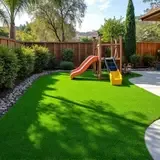
Phoenix Artificial Turf Playground Turf
A playground surface is bought for one number - the fall height it is rated to - and everything else about the installation serves that number.
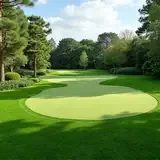
Phoenix Artificial Turf Putting Greens
A backyard putting green is a shaped base with a surface stretched over it, and the published specification starts with the speed number the surface has to deliver.

Phoenix Artificial Turf Commercial Turf
Commercial turf is published as a high-traffic, high-drainage surface, and the two numbers that decide whether it works are the annual hours it is rated for and how fast the base sheds water.
Areas we serve
Phoenix
Artificial Turf in Phoenix, AZ - costs, water and soil notes.
Scottsdale
Artificial Turf in Scottsdale, AZ - costs, water and soil notes.
Chandler
Artificial Turf in Chandler, AZ - costs, water and soil notes.
Gilbert
Artificial Turf in Gilbert, AZ - costs, water and soil notes.
Mesa
Artificial Turf in Mesa, AZ - costs, water and soil notes.
Tempe
Artificial Turf in Tempe, AZ - costs, water and soil notes.
Glendale
Artificial Turf in Glendale, AZ - costs, water and soil notes.