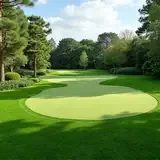
Putting greens in Phoenix are published as a custom build rather than a lawn: a tour-grade nylon surface with a published stimp meter rating of 9-11, multiple cups with adjustable pin positions, a longer fringe around the green for chipping, a real sand bunker for practice, and breaks built into the surface as undulation. The published market bands for turf work in this market are 8 to 15 per square foot installed, and 5 to 15 per square foot for a complete professional installation including removal, excavation, a crushed-rock base, turf and infill, with the source publishing line items - 1 to 3 per square foot for removal and hauling, 1 to 3 for excavation and a compacted base, 2 to 4 for basic turf material, 4 to 8 for premium high-face-weight material - rather than a separate green rate. The published base is open-graded #57 or CA7 angular stone compacted in 2-inch lifts to 95% Standard Proctor at a 1% to 2% slope, and a finished surface is published at 15-20 years. Phoenix Artificial Turf is a free matching service, not a provider: we route your request to licensed local installers, we do not employ contractors, and we do not sell putting green services.
What it costs in Scottsdale
| Job | Published 2026 range |
|---|---|
| Removal of the existing lawn and debris hauling, added to the installation | 1 - 3 per square foot |
| Excavation and a compacted crushed-rock base, added to the installation | 1 - 3 per square foot |
| Class II road base aggregate | $40 per ton |
| No. 57 clean washed angular stone | $48 per ton |
| Non-woven geotextile soil separator placed under the base | $0.45 per square foot |
| Basic turf with silica sand infill, per square foot installed | $4.00 per square foot |
| Rapid-drain turf with zeolite infill, per square foot installed | $6.00 per square foot |
| Standard installation labour | $5.50 per square foot |
| Pet-spec installation labour, deeper dig and edge pinning | $6.50 per square foot |
| Permit allowance, where the jurisdiction requires one | 100 - 500 |
| Spot repairs and small fixes | a few hundred to several thousand depending on scope |
What a putting green installation actually involves
A green is a precision build, and the published specification names its components rather than describing a look. The published surface is tour-grade nylon with a stimp meter rating of 9-11, which is the number that decides how the ball rolls; on top of that, the published features are multiple cups with adjustable pin positions, a fringe of longer turf around the green for chipping, a real sand bunker for practice, and undulation with breaks built into the surface.
| Element | Published description | What it decides |
|---|---|---|
| Surface | Tour-grade nylon, published stimp meter rating 9-11 | Roll speed, and how true a putt holds its line |
| Cups | Multiple cups with adjustable pin positions | Whether the pin can be moved to practise different putts |
| Fringe | Longer turf around the green | Chipping practice off the collar |
| Bunker | A real sand trap | Bunker practice without leaving the yard |
| Undulation | Breaks built into the surface | Slope and break, which are built into the base, not the carpet |
The published consequence of that list is that the shaped part of the job is the base. Undulation and break are built, not laid, so the green is a grading exercise with a surface on it - and the same published base rules that make a lawn last are what hold a green's shape.
The published cost bands and what a green adds
The source material publishes market-wide turf bands rather than a putting-green rate, so a green quote has to be read as the same components with more shape in them. The published bands are:
| Scope | Published band |
|---|---|
| Complete professional installation, per square foot | 5 to 15 |
| Installed artificial turf in this market, per square foot | 8 to 15 |
| Removing an existing lawn and hauling debris, per square foot | 1 to 3 |
| Excavation plus a compacted crushed-rock base, per square foot | 1 to 3 |
| Basic turf material, per square foot | 2 to 4 |
| Premium high-face-weight turf material, per square foot | 4 to 8 |
| Typical 500-square-foot area, whole job | 4,000 - 7,500 |
| Whole-project band published for the market | 15,000 and 35,000 |
Three published points apply to a green. The two published shapes disagree - the per-square-foot rate and the 15,000 to 35,000 whole-project band are not the same job - so ask which applies to your scope rather than blending them. A green uses premium surface material, which puts it at the 4 to 8 end of the material line rather than the 2 to 4 basic end. And the extras that make it a green - cup sleeves, a fringe cut from longer turf, a real sand trap and shaped base work - are published as features of the build rather than as separate published rates, which is exactly the part to have itemised in writing before comparing two quotes.
Why a green is a base project in the Valley of the Sun
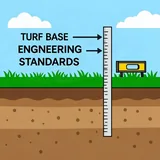
Undulation is published as breaks built into the surface, and that only happens if the base is graded and compacted to hold it. The published base specification is the same as any turf job in this market, with the tolerance mattering more because a green is a precision surface:
| Specification | Published figure |
|---|---|
| Compaction | 95% Standard Proctor density minimum, in damp 2-inch lifts with a plate compactor; never accept a base below 85% |
| Aggregate | #57 crushed stone, 3/4-inch down to 1/4-inch clean washed angular, or CA7 clear gravel, with 3/8-inch clean chip stone (ASTM #8 or High-Performance Bedding) as the bedding layer |
| Grading | Minimum 1% to 2% slope draining away from buildings, with the break built into the surface deliberately |
| Finished base | Exactly 1.5 inches below the top of the border or edging |
| Tonnage | 1 ton per 100 sq ft at a 3-inch depth; 1.33 tons per 100 sq ft at 4 inches; plus an extra 10% for the 8 to 10% of settling |
The published climate and soil notes matter here too. Phoenix is a 110 F-plus summer metro with an extreme-UV load and a storm-peaked monsoon. The NWS Phoenix forecast office publishes daily probability tiers for the metro at 100, 105, 110 and 120 F and keeps a running yearly count of Phoenix days at or above 110 F (https://www.weather.gov/psr/heat, HTTP 200), and the monsoon season runs through September 30, bringing the dust storms (wind gusts 40-60 mph) and thunderstorms NWS calls the most dangerous weather period of the Southwest year (https://www.weather.gov/psr/MonsoonSafety, HTTP 200). Sun load is the second half of the exposure: on EPA's UV Index scale everything at 8 and above is 'very high to extreme', where EPA advises extra protection even outside of peak hours (https://www.epa.gov/sunsafety/uv-index-scale-0, HTTP 200). The practical consequences for artificial turf are that shade and heat/UV tolerance drive the surface, infill and base specification rather than looks, and that the usable season inverts: roughly October through May is the comfortable season for installation and use, while June through September is the survival season for both people and finishes.
The Salt River Valley floor is mapped almost entirely in hyperthermic, calcareous USDA-NRCS soils, and the local 'caliche' is a real mapped layer rather than a construction myth: the Pinal series (loamy, mixed, superactive, hyperthermic, shallow Typic Haplodurids) has a silica-lime indurated duripan - cemented hardpan - at roughly 12 to 18 inches in Maricopa County (https://soilseries.sc.egov.usda.gov/OSD_Docs/P/PINAL.html, HTTP 200), while Laveen Haplocalcids carry a calcic horizon from as shallow as 3 inches (https://soilseries.sc.egov.usda.gov/OSD_Docs/L/LAVEEN.html, HTTP 200) and Mohall Calciargids from 20 to 40 inches (https://soilseries.sc.egov.usda.gov/OSD_Docs/M/MOHALL.html, HTTP 200). For an artificial turf installation that means three things: base excavation and edge-restraint pins can stop on cemented hardpan well short of the intended depth; trenching an irrigation, drainage or low-voltage lighting run through a duripan or petrocalcic layer can require a breaker rather than a shovel; and because those layers slow water movement, grading, drainage and runoff detail matter more than the soil name on the map (check the specific lot with USDA-NRCS Web Soil Survey, https://websoilsurvey.nrcs.usda.gov/app/).
A surface held down tight is the published requirement in these conditions, because a base that moves takes the break with it and a green that has lost its shape cannot be re-tuned without rebuilding the base.
Local note for Scottsdale
Scottsdale sampling (USDA-NRCS Soil Data Access) returns Laveen loam and Cavelt gravelly loam, with rough broken land on the slopes; Cavelt is a shallow Typic Petrocalcids, meaning a cemented petrocalcic hardpan sits within the shallow depth class (https://soilseries.sc.egov.usda.gov/OSD_Docs/C/CAVELT.html, HTTP 200), and Laveen is a Typic Haplocalcids whose calcic horizon ranges from 3 to 34 inches deep (https://soilseries.sc.egov.usda.gov/OSD_Docs/L/LAVEEN.html, HTTP 200) - so hillside and north-Scottsdale footings can reach caliche quickly.
Scottsdale Water's main surface supply is Colorado River water carried through the 336-mile Central Arizona Project canal to the CAP Water Treatment Plant at the Scottsdale Water Campus, and the city reports that more than 90 percent of total supply now comes from renewable surface water and recycled water - a reversal from the pre-1980s position of complete groundwater reliance (2026 Water Quality Report, https://www.scottsdaleaz.gov/docs/default-source/scottsdaleaz/water/water-quality/annual-reports/2026-water-quality-report.pdf, HTTP 200). The 2025 report describes the CAP plant as able to treat up to 70 million gallons per day, with the SRP Salt/Verde share delivered by canal as the other surface source (https://www.scottsdaleaz.gov/docs/default-source/scottsdaleaz/water/water-quality/annual-reports/2025-water-quality-report.pdf, HTTP 200); the annual report carries the current hardness and mineral figures for a given service area.
Utility accounts: Scottsdale Water (City of Scottsdale) · 480-312-5650
Checking a quote in Scottsdale
- How deep will you excavate, and is that depth stated in the contract with the aggregate type?
- Which base material is specified - open-graded washed angular stone, or a dense-graded road base - and where does it come from?
- What compaction target do you build to, and how do you verify it before the turf goes down?
- Where will the drainage slope run on my lot, and how does water and dog urine leave the surface?
- Is the removal of the old lawn, the sprinkler capping and the debris disposal inside the quote or billed separately?
- What infill are you using, how many pounds per square foot, and is the seam and workmanship warranty separate from the turf manufacturer's warranty?
Frequently asked questions
How much does a putting green cost in Phoenix?
The source material publishes market-wide turf bands rather than a putting-green rate: 8 to 15 per square foot installed, or 5 to 15 per square foot for a complete professional installation including removal, excavation, base, turf and infill. Read as line items, removal and hauling is 1 to 3 per square foot, excavation and a compacted base another 1 to 3, basic turf material 2 to 4, and premium high-face-weight material 4 to 8 - a green sits at the premium end. The published whole-project band for the market is 15,000 and 35,000, which disagrees with the per-square-foot shape, so ask which applies to your scope.
How fast is a backyard putting green?
The published specification is a tour-grade nylon surface with a stimp meter rating of 9-11. Speed is published as a property of the fiber, the infill and the base together, so a target that is not specified up front is not something that can be tuned afterward. Ask for the stimp target in writing, ask how it is checked on the finished surface, and ask how the infill is maintained, because infill is what supports the fiber and the roll.
What does a putting green include?
The published features are a tour-grade nylon surface at a stimp rating of 9-11, multiple cups with adjustable pin positions, a fringe of longer turf around the green for chipping, a real sand bunker for practice, and undulation with breaks built into the surface. The shaped parts - the break, the bunker and the base that holds them - are built before the surface goes down, which is why the drainage and compaction specification is what the finish actually depends on.